
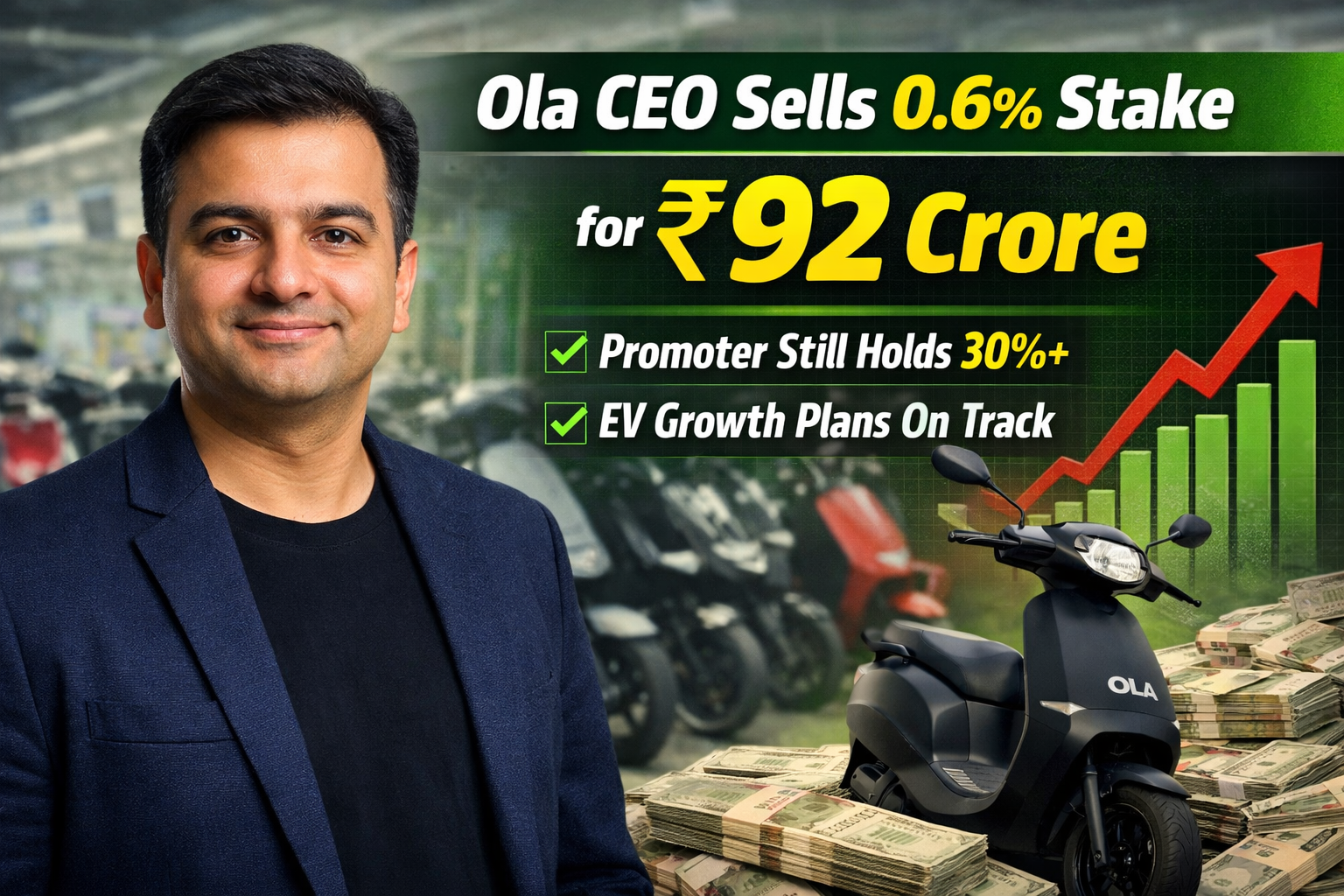
Ola has once again captured investor attention after Founder and CEO Bhavish Aggarwal sold 0.6% of his stake in Ola for nearly ₹92 crore through a bulk deal. The news quickly spread across the market and created curiosity among traders who monitor every small movement in Ola and the Indian electric vehicle space. Promoter activity usually triggers emotional responses because retail investors often assume any equity sale means loss of confidence. However, in this situation, the available data suggests a very routine and harmless liquidity decision. The bulk deal averaged around ₹34.99 per share, pushing the total transaction amount near ₹92 crore. Even though the number sounds dramatic in headlines, the proportional ownership movement is extremely small. A stake sale of only 0.6% does not affect control, voting power, or strategic influence. Bhavish Aggarwal still owns more than 30% of Ola, which ensures that the founder continues to guide product development, gigafactory investments, pricing plans, and business expansion. If a promoter truly wanted to exit Ola, the reduction would be several percentage points, not a microscopic adjustment like 0.6%.
Because Ola operates in a high-attention sector involving electric mobility and ride-hailing, every disclosure attracts speculation. Investors may assume Ola is facing declining scooter demand, rising competition, or cash problems. But none of these assumptions match the facts. Promoters around the world frequently sell small amounts of equity for a range of practical reasons including personal diversification, tax planning, repayment of loans, liquidity for new ventures, or family office allocation. Therefore, this Ola sale must be viewed with rational understanding rather than panic. Bhavish Aggarwal continues as Ola’s leading promoter, and a founder-driven business is more predictable than a management-only structure. Especially in the EV sector, decisions must be quick because technology, pricing, chemistry, and consumer sentiment change rapidly. With more than 30% ownership, the leadership at Ola operates with clarity and long-term commitment.
Retail investors often react before evaluating data. That emotional response explains why the Ola sale became a trending topic across financial communities. However, there is no evidence linking the equity movement to operational stress. Ola scooter registrations continue across major states. The government continues supporting EV purchases through incentives. India’s shift away from fossil fuels supports the adoption of two-wheeler electrification. All these structural drivers support Ola rather than weaken it. Ola is actively building a gigantic gigafactory for battery production. Local cell manufacturing means Ola can eventually reduce input costs and control margins because battery packs contribute the largest portion of EV production cost. Once Ola brings full integration between vehicle design, battery chemistry, and large-scale assembly, the company gains pricing power.
Riders increasingly understand the economic advantage of replacing petrol scooters with Ola electric models. Charging a scooter at home costs a fraction of refueling with petrol. Maintenance is simpler because electric motors have fewer moving parts. Once consumers experience such savings, they rarely switch back. India is still in the early adoption stage of electric mobility. Only a small portion of two-wheelers are electric today, which means Ola has a vast runway ahead. Eventually, lower battery costs, increasing public chargers, policy incentives, and mass behavior will accelerate EV expansion. When that happens, brands that entered the market early—like Ola—will likely stay ahead.
Bhavish Aggarwal’s strategic intensity remains a core asset for Ola. His decisions in both mobility and electrification have been bold and transformative. Whether scaling ride-hailing platforms or launching electric scooters at industrial speed, his presence has been decisive. Therefore, a 0.6% sale cannot be mistaken for emotional withdrawal. Founders in global businesses routinely liquidate small personal stakes while remaining fully engaged. The sale may even support capital efficiency because it cleans up personal liquidity.
Short-term traders may use promoter events to trigger sell-offs or speculation, but long-term investors look at real business engines. For Ola, those engines include manufacturing expansion, supply chain efficiencies, battery research, sales volume growth, upcoming motorcycle launches, after-sales service, and possible export expansion. None of those engines have been affected. The transaction does not weaken Ola’s production scale, demand metrics, or technological roadmap.
Ola also benefits from strong alignment with government policy. India has declared EV growth a national priority in order to reduce oil imports, lower pollution, and promote domestic manufacturing. Ola fits directly into each mission. The gigafactory supports Indian manufacturing. Electric scooters reduce national petroleum dependence. Distributed charging networks support clean mobility. Battery innovation supports economic efficiency. These policy tailwinds give Ola an advantage. Global EV competitors face high import costs and higher landing expenses. Ola, with domestic manufacturing, can reduce cost curves faster.
When Ola eventually brings electric motorcycles or new EV categories into the market, consumers could see price points far below international products. The combination of domestic battery output and local assembly creates affordability advantages. Investors evaluating Ola must therefore look at long-term structural positioning instead of short-term emotion. The recent transaction is not a verdict on Ola’s business. It is merely a liquidity exercise. The founder remains committed. The business remains active. The EV timeline remains favorable.
Some investors assume promoter selling equals fear. But if Bhavish Aggarwal were afraid of Ola’s future, he would not still own more than 30% of the company. The number itself is proof of confidence. A promoter holding that high has personal financial exposure to company success. No one maintains such exposure without conviction. This is why analysts have not reacted negatively. There is no change in management control. There is no change in shareholder control. There is no attempt to exit. There is no operational weakness.
Ola is a company operating at the intersection of mobility, electrification, automation, software, and manufacturing. These sectors are undergoing long-term transition. Winners emerge through volume scaling, efficiency improvement, customer education, and distribution expansion. One small equity movement cannot overshadow a transformation that may stretch across a decade. Ola continues building laboratories, production lines, and service footprints, all of which matter more than one promotional adjustment.
The bottom line is simple. Ola attracted attention because Bhavish Aggarwal sold 0.6% for ₹92 crore. But promoter control above 30% means Ola remains founder-directed and secure. Market fundamentals have not changed. Consumer interest has not slowed. Government policy has not weakened. Gigafactory construction signals confidence, not confusion. India’s move toward EV dominance is just beginning. Ola remains positioned for growth rather than decline. The mobility evolution in India is still opening chapters, and Ola continues to be a leading character in that story.