
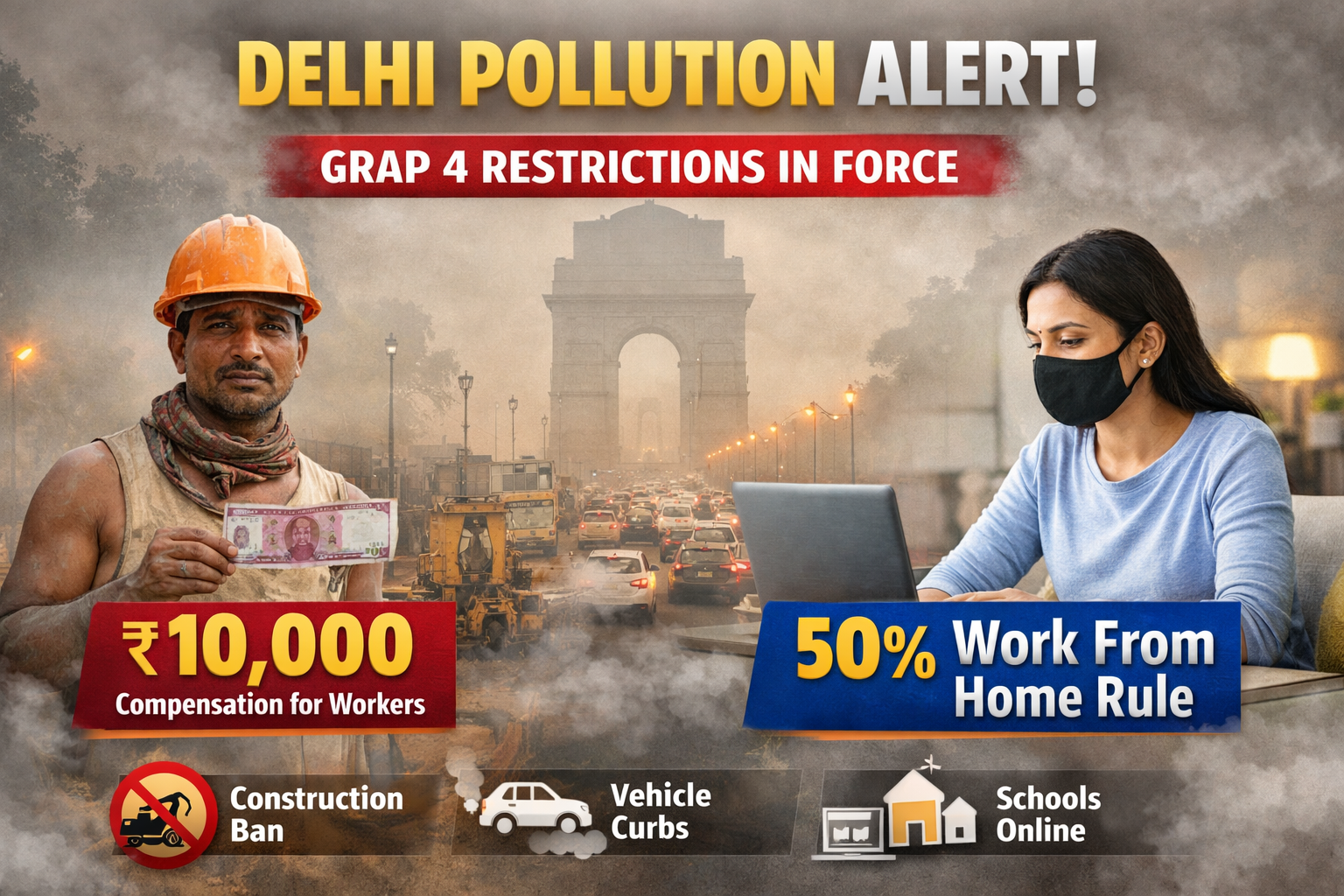
Delhi-NCR is once again facing a public health emergency as air pollution reaches hazardous limits, triggering the strictest category of the Graded Response Action Plan, GRAP Stage IV. Under this phase, the Delhi government has issued two major decisions — ₹10,000 financial compensation for registered workers and a mandatory 50% work-from-home rule for all offices. These urgent measures address economic disruption caused by construction bans and aim to reduce vehicular emissions, which are among the biggest pollution contributors in the capital.
Understanding the Delhi Pollution Emergency
Every winter, pollution in Delhi spikes due to a combination of weather and environmental conditions. The current episode has pushed Air Quality Index values into the “Severe” and “Severe+” categories, meaning the air is unsafe for the general population and especially vulnerable groups. Key causes include slow wind movement, farm stubble burning, dust from construction sites, increased road traffic, and industrial emissions. Authorities warn that prolonged exposure to such pollution can damage lungs, increase hospitalization, trigger asthma attacks, and worsen cardiovascular disorders.
What Is GRAP and Why Stage IV Matters
The Graded Response Action Plan (GRAP) activates anti-pollution actions based on air quality. Delhi is now under GRAP Stage IV, the most stringent level, which restricts construction, industrial operations, and movement. Under Stage IV, diesel trucks and older vehicles can face restrictions, construction and demolition work halts, industries using dirty fuels stop functioning, public movements are discouraged, and WFH advisories become mandatory. The goal is to rapidly reduce pollution emissions and protect health.
₹10,000 Compensation for Workers Affected by Pollution Restrictions
Construction workers suffer the most during anti-pollution crackdowns because work stops instantly. To support them, the Delhi government has approved a ₹10,000 Direct Benefit Transfer relief payment. Registered construction workers listed in the state labour database who lost income because of GRAP restrictions are eligible. This relief prevents wage loss from turning into deeper economic distress. Many workers rely on daily income for food, housing, and school fees, making this support essential.
50% Mandatory Work-From-Home to Reduce Vehicular Emissions
Vehicular emissions are a core cause of Delhi’s pollution crisis. To reduce traffic, the government has ordered 50% mandatory work-from-home. The rule applies to both government and private offices. Only essential services like hospitals, sanitation, emergency services, transportation, energy and police are exempt. Reducing traffic lowers fuel combustion, curbs tailpipe emissions, and limits outdoor exposure to polluted air. This helps employers operate safely while reducing environmental strain.
Pollution and Public Health – A Growing Threat
Doctors repeatedly warn that pollution is now a year-round health hazard. Severe air quality causes airway inflammation, chronic bronchitis, reduced lung capacity in children, cardiovascular risks, eye and throat irritation, and worsening asthma. Children, seniors, and pregnant women are most at risk. Citizens are advised to avoid jogging outdoors, use N95 masks, run indoor purifiers, and avoid unnecessary travel during peak pollution days.
Pollution Rules for Vehicles and Fuel Purchase
To enforce compliance, fuel stations are instructed to deny petrol or diesel to vehicles without valid PUC certification. This discourages use of polluting vehicles and forces regular emission checks. Older diesel vehicles and non-compliant commercial fleets face increased scrutiny. Vehicle emissions form a major share of urban pollution, and enforcing PUC compliance is a necessary control step.
Impact on Schools and Children
Because children face the highest risk from toxic air, schools are permitted to run online or hybrid classes. Young lungs are still developing, and pollution can cause lifelong respiratory damage. Adjusting school schedules keeps students safe while maintaining education continuity.
How Citizens Can Help Reduce Pollution
Every resident can contribute to lowering pollution by using public transportation, avoiding waste burning, minimizing vehicle use, carpooling, wearing N95 masks outdoors, purifying indoor air, and adopting electric mobility wherever possible. Individual participation supports government efforts.
Long-Term Solutions Required Beyond GRAP
GRAP provides emergency pollution response, but Delhi needs structural change. Long-term solutions include shifting to clean energy, reforming waste management, running crop residue programs, supporting electric mobility, increasing green cover, modernizing public transport, and enforcing industrial standards. Collaboration between central and state authorities is essential because pollution comes from multiple states and sectors.
Conclusion – Pollution Is an Economic and Health Emergency
Pollution is not only an environmental challenge but a humanitarian and economic crisis. The Delhi government’s decisions, including ₹10,000 for workers and 50% mandatory WFH, reflect strong action under GRAP Stage IV. Reducing pollution requires governance, industry compliance, and public cooperation. Until pollution falls, winter health emergencies will continue.