
Delhi Vehicle Ban 2024: How to Check If Your Car Is BS-4 or BS-6
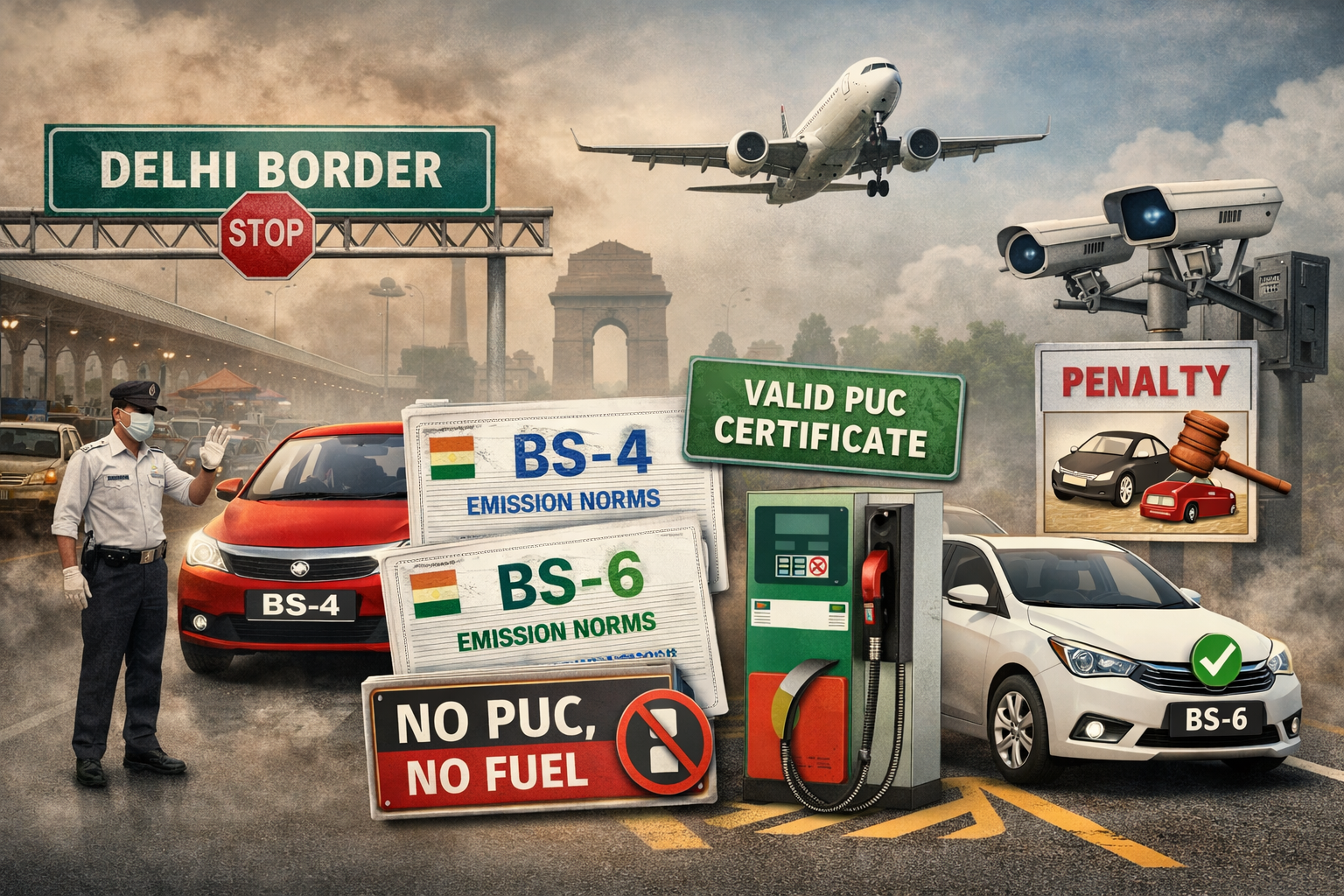
Delhi has once again woken up to polluted skies, triggering the strongest response under the Graded Response Action Plan (GRAP) Stage-IV. While news usually focuses on flight delays during extreme smog, this time the harshest restrictions apply to road vehicles—especially those entering Delhi from NCR borders. Under the new rule enforced by the Delhi government, vehicles registered outside Delhi that do not meet BS-VI emission standards are banned from entering the capital. Meanwhile, fuel will not be provided to any vehicle without a valid PUC (Pollution Under Control) certificate, regardless of whether it runs on petrol, diesel or CNG. Although the keyword “flight” is dominating online searches because of visibility issues and airborne restrictions during smog events, the real pressure is now on road mobility. Millions of daily commuters may feel as though their daily drive has turned into a regulatory flight check—approve emissions, or no entry. This article explains everything NCR drivers need to know: what the order means, who is restricted, how to check BS-3, BS-4, or BS-6 status, how the PUC rule works, and how to avoid penalties.
GRAP Stage-IV: The Most Severe Anti-Pollution Action
GRAP Stage-IV activates only when air quality moves into the Severe+ category, posing dangerous threats to health and mobility. While citizens worry about flight cancellations, the government has moved aggressively to reduce ground-level emissions—where particulate matter is the worst. The order has been issued under Section 5 of the Environment (Protection) Act, 1986, giving authorities sweeping power to stop or penalize non-compliant vehicles until GRAP Stage-IV is revoked.
Key Highlights of the Order
No entry for vehicles registered outside Delhi unless they are BS-VI. No fuel without valid PUC certification. Verification will be done via physical documents, ANPR cameras, VAHAN database and voice-alert systems. Immediate penalty for violations. This initiative is expected to affect nearly 1.2 million vehicles that enter Delhi daily from Gurugram, Faridabad, Noida, and Ghaziabad. For many NCR drivers, the fear is similar to boarding a flight with improper documents—your vehicle may be stopped the moment it crosses into Delhi.
Why BS-VI Matters More Than Ever
The Indian government introduced Bharat Stage (BS) emission norms to control vehicular pollution. BS-3 typically refers to vehicles made before 2010. BS-4 covers most models from 2010 to March 2020. BS-6 applies to all vehicles manufactured from April 2020 onward. Since BS-6 engines emit significantly lower nitrogen oxides and particulate matter, Delhi wants nothing less on its roads. Even courts have stepped in. The Supreme Court has permitted strict action against BS-4 and older vehicles, especially those operating inside Delhi-NCR.
No PUC, No Fuel—What It Means for Drivers
The “No PUC, No Fuel” rule applies to all vehicles—new or old, Delhi-registered or NCR-registered. Fuel pumps must deny fuel if the driver cannot show a valid PUC certificate, if ANPR cameras detect non-compliance, or if VAHAN records show expired PUC. This applies to petrol, diesel, and CNG. Skipping a PUC check could result in immediate penalty, vehicle seizure, and a possible driving ban. Just like an aircraft cannot begin a flight without clearance, a car cannot refuel without PUC approval.
How to Check Whether Your Vehicle Is BS-3, BS-4, or BS-6
Confusion has spread across NCR. Drivers don’t know whether their vehicle falls in the banned list. A wrong assumption can lead to hefty fines. Here’s how to confirm.
- Check the RC (Registration Certificate)
This is the most reliable confirmation. Locate the “Emission Norms” or “Fuel Norms” field. It will clearly state BS-3, BS-4, BS-5 or BS-6. If your RC was issued before 2010, it is likely BS-3. If issued between 2010–2020, it is usually BS-4. Digital RCs stored in apps like DigiLocker also show this information.
- Use Manufacturing Year as a Second Clue
This isn’t always accurate, but it helps. 2005–2010 usually means BS-3. 2010–2020 mostly indicates BS-4. April 2020 onward means BS-6. Because exceptions exist, rely on RC for confirmation, just as a flight passenger relies on an official boarding pass.
- Identify Through Engine or Chassis Number
Manufacturers encode emission data in the engine number, chassis number or Vehicle Identification Number (VIN). Visit the manufacturer’s website, call customer care, or contact an authorized dealer. Provide VIN details and confirm the BS rating.
- Check Your PUC Certificate
Sometimes PUC certificates mention emission norms, though this varies by state. If unclear, ask the PUC operator to confirm.
- Look for Emission Stickers or Under-Bonnet Labels
Many vehicles contain labels in the engine bay, door frame, or under the bonnet mentioning BS-3 or BS-4. These may fade or fall off, so do not treat this as final proof.
- Use the mParivahan Mobile App
This is the fastest and most accurate digital method. Enter your vehicle number and view fuel type, registration date and emission norm. Since it pulls data from government servers, it’s as reliable as checking flight status from official aviation sources.
Why Accuracy Matters
Wrong assumptions can lead to serious consequences—heavy penalties, fuel blockage, vehicle seizure and legal trouble. A one-minute check can save major frustration at Delhi borders. Drivers already struggle with traffic, smog-induced sickness, and flight delays caused by low visibility—adding a forced vehicle seizure is unnecessary stress.
What NCR Drivers Should Do Immediately
Verify BS status before entering Delhi. Keep a printed or digital PUC handy. Renew PUC before expiry. Avoid older diesel vehicles. Follow updates from Delhi government and CAQM. If you are unsure, do not take a risky “test flight” into Delhi traffic. Confirm first.
Will the Ban Reduce Flights of Polluting Vehicles?
Yes. Just as air traffic control regulates flights for safety, Delhi is regulating vehicle entry for public health. Removing 12 lakh non-compliant vehicles daily is expected to improve visibility, lower PM2.5 levels and stabilize mobility faster—on roads and in the air.
Conclusion: Compliance Is the Only Way Forward
Delhi’s pollution crisis is recurring, but this time the rules are strict and data-driven. The ban is temporary, but compliance is mandatory. Think of Delhi’s borders like airport security—no valid emission clearance, no entry. Check your BS rating, update your PUC, drive responsibly—and help the capital breathe again.