
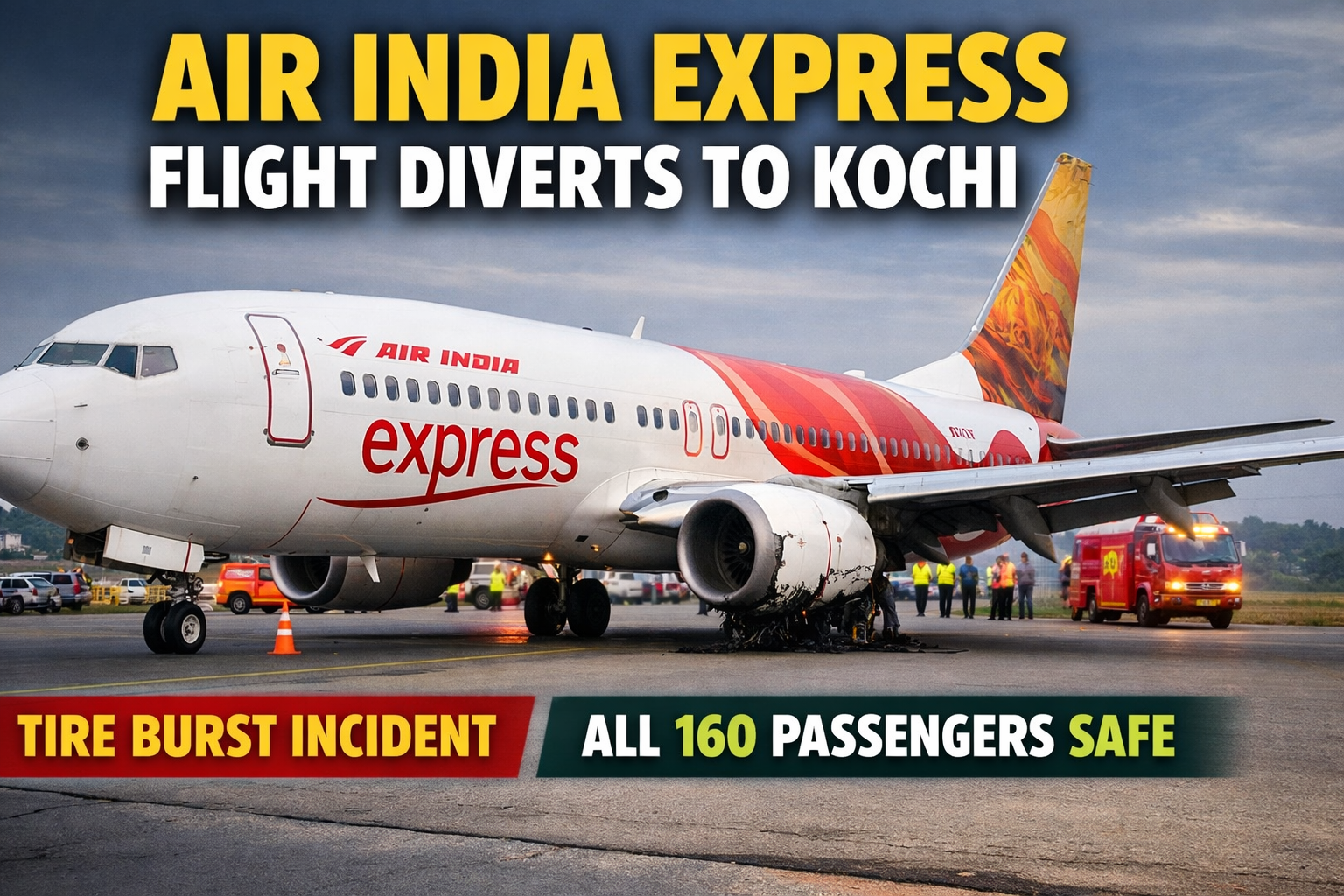
Air India Express Flight Diverts Safely: 160 Passengers Safe
A recent incident involving Air India Express, a subsidiary of Air India, has once again highlighted how critical safety decisions can prevent major aviation risks. On Thursday morning, passengers onboard flight IX-398, traveling from Jeddah to Kozhikode (Calicut), faced an unexpected situation when the aircraft’s right main landing-gear tires burst mid-flight. The pilots diverted the aircraft to Cochin International Airport, where it landed safely at 9:07 AM with 160 passengers on board. Airport authorities confirmed that emergency protocols were activated well in advance, ensuring that fire and rescue services were available on the runway. Fortunately, there were no injuries to passengers or crew, and the situation was handled smoothly—an outcome that reflects well on Air India’s safety standards and aviation preparedness. This event has been widely discussed because such diversions are not simply routine choices—especially when the original destination is a table-top airport like Kozhikode.
What Led to the Emergency Diversion?
According to a statement issued by Cochin International Airport Limited (CIAL), the Air India Express aircraft was diverted due to a failure of the right-side main landing gear tires. After landing, the inspection confirmed that two tires on the same side had burst. An Air India spokesperson clarified that there was no malfunction of the landing gear system—only the tires were damaged. Therefore, the landing at Kochi was described as a “precautionary landing,” not an emergency landing. However, when a destination airport comes with additional structural challenges, precaution becomes essential.
Why Landing at Kozhikode Can Be Risky
The Kozhikode (Karipur) airport is a table-top runway, built on an elevated plateau. Such runways demand absolute precision in landing distance and braking performance. If an aircraft overshoots or skids, it can slide off the edge into steep terrain. There are five major challenges pilots face when attempting an emergency landing at Kozhikode: the runway sits on a height with steep drop-offs at both ends, increasing the risk of runway excursions; the runway length is limited and emergency operations require more stopping distance, especially when tires are compromised; in case of reduced braking ability, an aircraft can slide directly down the slope—leading to catastrophic outcomes; rain, strong winds, and changing visibility often worsen risk during emergency approaches; and because of these hazards, pilots usually favor larger airports like Kannur or Kochi if something goes wrong. These reasons make the diversion decision by the Air India crew not only sensible but also crucial for safety. Aviation professionals often emphasize that precautionary diversions are signs of strong safety culture—something Air India has been focusing on as part of its modernization and training upgrades.
How Air India Responded to Passenger Needs
After the safe landing, all passengers were accommodated inside the airport lounge, receiving refreshments and updates from airline staff. Air India Express also assured that they are arranging alternate travel to Kozhikode. If the onward flight cannot operate on schedule, passengers will be transported by road—a journey of around seven hours from Kochi to Kozhikode. For an airline, what matters most after a diversion is customer management, and Air India has shown a calm, transparent, and reassuring response.
Air India, Emergency Protocols, and Improving Safety Reputation
In recent years, Air India—now under the Tata Group—has been working toward a complete overhaul of its fleet standards, service quality, and safety culture. Incidents like these test a company’s preparedness. A well-executed precautionary landing demonstrates fast decision-making by the cockpit crew, clear communication with ATC (Air Traffic Control), airport readiness with fire, ambulance, and technical teams, and airline responsibility toward passenger comfort and onward travel. Passengers onboard the diverted Air India Express aircraft experienced inconvenience, but no panic and no medical emergencies—a testament to operational discipline. In global aviation standards, this is what matters: safety first, schedules second.
Understanding What Tire Bursts Mean in Aviation
For many travelers, a tire burst sounds alarming. But in aviation, tire stress during landing and take-off is significant, and bursts do happen occasionally—especially under heavy loads or high temperatures. Aircraft tires are engineered to withstand extreme pressure, continue supporting the aircraft even if partially damaged, and allow pilots to land safely with backup systems. When pilots receive a tire-burst alert, they typically reduce landing weight if possible, divert to a longer runway, coordinate support services on ground, and land at reduced speed to minimize strain. This is why Kochi’s runway was ideal—it is wide, long, and supported by full-scale emergency response, unlike a table-top runway where mobility is limited.
What This Incident Means for Air India Travelers
For frequent travelers, this event highlights a reassuring message: Air India pilots do not take chances. The aviation regulator in India encourages diversions and does not penalize pilots for prioritizing safety. In fact, diverting early—before a minor issue becomes a major one—is part of responsible aviation culture. Travelers should take note that diversions are normal safety decisions, not every abnormality equals danger, modern aircraft are designed to tolerate system failures, and Air India is upgrading safety standards significantly. For passengers of Air India Express flight IX-398, the biggest outcome was a safe landing, no injuries, and a managed onward journey.
Air India’s Future: Safety, Upgrades, and Global Vision
Under Tata Group, Air India is undergoing historic growth: new aircraft orders, upgraded engineering checks, digital maintenance systems, improved pilot training, and stronger safety monitoring. When airlines invest in safety, passengers experience fewer disruptions in the long run—even if precautionary measures temporarily slow travel. This incident is not a setback for Air India—instead, it is proof that the airline culture is moving in the right direction.
Final Thoughts: Safety Over Speed, Always
The Air India Express diversion from Jeddah to Kochi is a story with a positive ending: 160 passengers are safe, no crew injuries, risk was prevented, and support services activated quickly. In aviation, these are the only metrics that matter. Air India reinforced confidence by choosing caution over risk—especially at a challenging airport like Kozhikode. Whether you are a frequent flyer or an occasional traveler, this incident shows that Air India continues to put human life above operational convenience. In the world of aviation, a safe landing—no matter where it happens—is a successful landing.