
Introduction: What Is Theory of Relativity?
The theory of relativity is not just a complex idea in physics. It’s a scientific revolution that completely changed how we understand space, time, motion, and gravity. Introduced by Albert Einstein in the early 20th century, it has become one of the most important theories in modern science.
The term “relativity” can sound intimidating, but it really means that things like time and space aren’t fixed. Instead, they depend on speed, gravity, and the observer. That’s a game-changer. Before Einstein, scientists thought space and time were absolute. But Einstein showed that they’re deeply connected and relative.
This theory has two main parts: special theory of relativity and general theory of relativity. Each one reveals a different aspect of how our universe works. And what’s even more fascinating is that this theory affects real things in our everyday lives, like GPS and mobile networks.
Understanding the theory of relativity helps you see the universe differently. And while it can seem technical at first, it becomes easier with clear examples. That’s exactly what you’ll find in this article.
Why Is the Theory of Relativity So Important?
The theory of relativity isn’t just an abstract idea in textbooks. It explains how the universe behaves at high speeds, in strong gravitational fields, and even at the edge of black holes. Without it, we wouldn’t understand how the cosmos works or how time and space interact.
It goes beyond physics labs and into your smartphone. GPS navigation depends on it. Time synchronization in communication systems relies on it. Even images from space telescopes are corrected using relativity. That’s how practical it is.
Einstein’s theory filled in the gaps left by Newton. Newton’s laws work well for everyday situations, but they fail in extreme conditions like near light speed or inside a black hole. That’s where relativity becomes essential.
Special Theory of Relativity Explained Simply
Einstein introduced the special theory of relativity in 1905. This part of the theory focuses on objects moving at constant speeds, especially speeds close to the speed of light. It was revolutionary because it introduced ideas that no one had imagined before.
One of the key points is that the laws of physics are the same for all observers who are moving at constant speeds relative to each other. That might not sound shocking at first. But when you add the next idea—that the speed of light is always constant, no matter how fast you’re moving—it changes everything.
These two ideas lead to surprising results: time moves slower for faster objects, moving objects shrink in length, and mass increases with speed. These effects are not just theoretical—they’ve been observed and measured.
Now let’s explore five real-life examples of the special theory of relativity.
- GPS Satellites
Your GPS works thanks to satellites orbiting Earth. These satellites move fast—so fast that their clocks tick slower than those on the ground. Without correcting this using the special theory of relativity, your GPS location would be off by several kilometers.
- Particle Accelerators
In places like CERN, scientists accelerate tiny particles to near light speed. These particles gain mass and behave according to Einstein’s equations, not Newton’s. That’s special relativity at work in cutting-edge science.
- Time Dilation in Airplanes
Precise atomic clocks flown on airplanes show different times compared to clocks on the ground. They lose time—just a tiny bit, but enough to prove that motion affects time.
- Muon Particles in the Atmosphere
Muons are short-lived particles formed in the Earth’s upper atmosphere. They should decay before reaching the ground. But because they travel so fast, time slows down for them, and they survive longer. This directly supports special relativity.
- The Speed of Light Barrier
Nothing can go faster than light. This isn’t just a belief—it’s a proven limit set by special relativity. It’s why space travel beyond a certain speed isn’t currently possible.
General Theory of Relativity Explained Simply
In 1915, Einstein expanded his ideas into the general theory of relativity. While special relativity dealt with constant speed, general relativity brought gravity into the picture. It’s more complex but just as fascinating.
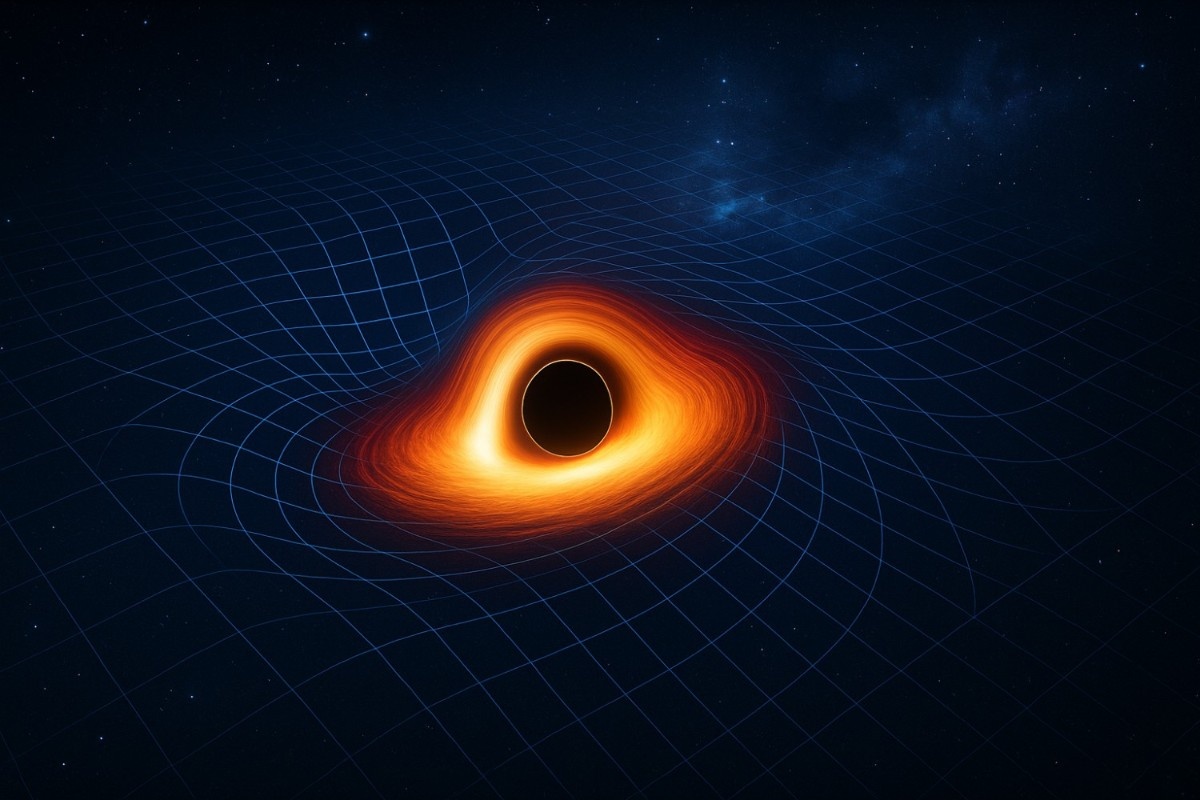
Instead of thinking about gravity as a force, Einstein described it as a warping of space-time. Imagine placing a heavy ball on a stretched sheet—the sheet bends. That’s what massive objects like Earth or the sun do to the space around them. Smaller objects follow the curves created by this bending, and that’s what we feel as gravity.
Let’s look at five examples that show general relativity in action.
- Light Bending Around the Sun
During solar eclipses, scientists observe starlight bending around the sun. This happens because the sun’s mass warps the space around it, changing the path of light. Einstein predicted this, and it was proven in 1919.
- Black Holes
Black holes are regions where space-time is curved so much that even light can’t escape. Their existence was first predicted by general relativity. Today, we’ve even photographed one, confirming Einstein’s ideas.
- Gravitational Time Dilation
Time runs slower near heavy objects. On Earth, this effect is tiny, but near a black hole, it’s extreme. This has been confirmed by comparing clocks at different altitudes and in orbit.
- Expansion of the Universe
General relativity supports the idea that space itself is expanding. That’s the basis of the Big Bang theory and explains why galaxies move away from us.
- Tides and Gravity
Earth’s tides are caused by the moon’s gravity. But the way gravity pulls differently on parts of Earth is explained by how space-time bends. That’s general relativity affecting something we see every day.
Key Concepts to Know
Time Dilation: Time is not fixed. It slows down the faster you move or the closer you are to a large mass.
Space-Time: This is a four-dimensional fabric that includes space and time. Mass and energy bend it.
The Speed of Light: Light always travels at the same speed—no matter who’s observing. This idea changed physics forever.
Mass-Energy Equivalence: This is where the famous equation E=mc² comes from. It shows how mass and energy are two forms of the same thing.
Special vs General Relativity
Let’s compare the two side by side:
| Aspect | Special Theory of Relativity | General Theory of Relativity |
|---|---|---|
| Introduced By | Albert Einstein (1905) | Albert Einstein (1915) |
| Focus | Constant speed motion | Acceleration and gravity |
| Includes Gravity | No | Yes |
| Space-Time Geometry | Flat (not curved) | Curved due to mass and energy |
| Main Concept | Laws of physics are same for all inertial observers | Gravity is the result of curved space-time |
| Time Dilation | Caused by relative speed | Caused by gravity (gravitational time dilation) |
| Key Application | GPS, particle physics, time dilation in motion | Black holes, gravitational lensing, cosmology |
| Mathematical Tools | Lorentz transformations | Tensor calculus and Einstein’s field equations |
| Speed of Light | Always constant in a vacuum | Still constant, but light path bends in curved space |
| Famous Equation | E = mc² | Not a single equation, but field equations of gravity |
Common Myths About Relativity
Some people think the theory of relativity is just a theory—it’s not. It’s backed by over a century of experiments. Others believe it proves time travel is possible. While time dilation exists, it’s not like what movies show. Relativity is not about imagination. It’s real, measurable science.
How It Affects Your Daily Life
Even if you’re not thinking about the theory of relativity, it’s influencing your day. GPS uses it to help you navigate. The internet depends on accurate timing. Satellites rely on Einstein’s equations. Every time you use a phone or map, relativity is working behind the scenes.
Final Thoughts
The theory of relativity changed everything we thought we knew about space, time, and gravity. Einstein showed that time isn’t absolute, that space can bend, and that gravity is a result of warped space-time. These aren’t just cool ideas—they affect the world we live in.
Learning about the theory of relativity helps you understand the universe more deeply. It helps you appreciate the science behind everyday technology. And it connects you to one of the greatest minds in human history.
So the next time someone mentions Einstein, you’ll know what made him so brilliant. He didn’t just explain the stars—he changed how we see ourselves in the universe.